What Locks Come With a New uPVC or Composite Door?
When you ask three companies to quote for a new front door, you will usually get three prices, three colour swatches and three descriptions of the slab itself. The locking hardware tends to be summarised in a single line, something like "high security multipoint lock and anti-snap cylinder". That line is doing a lot of work, and it can mean very different things depending on who wrote it.
This guide explains what the locking package on a new uPVC or composite door actually consists of, what the building regulations do and do not require, and the specific questions to ask so that the hardware you are paying for is the hardware that turns up on fitting day.
The multipoint lock: what it is and how it works
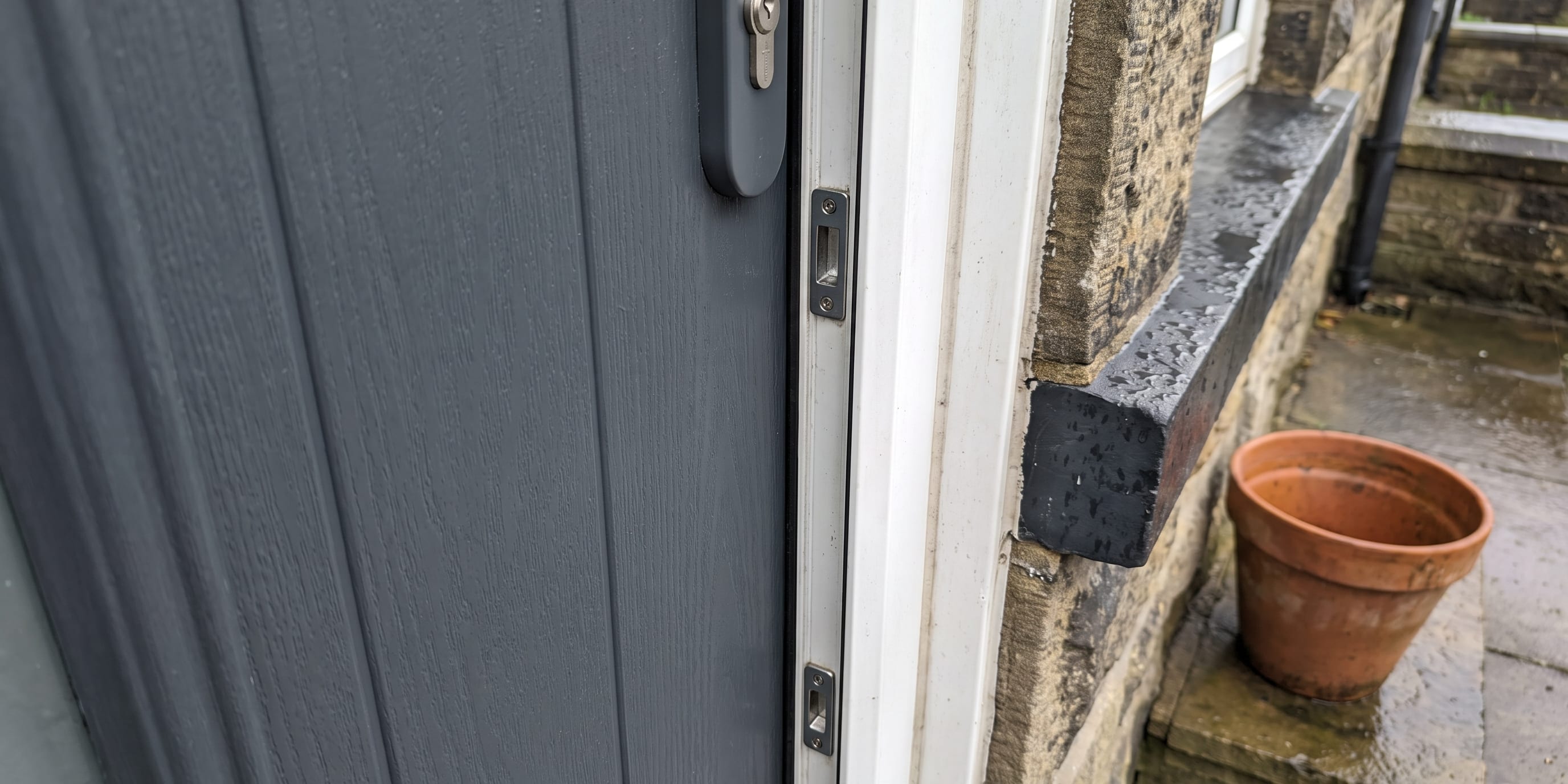
Almost every modern uPVC or composite door is fitted with a multipoint locking mechanism. Instead of a single latch and deadbolt in the middle of the door, a long metal strip runs the full height of the door edge, with several locking points spread along it. When those points engage, the door is held tight to the frame at the top, middle and bottom rather than at one spot in the centre.
From the inside, there are two actions. Lifting the handle upwards drives the mechanism and throws the locking points out into the keeps on the frame. Turning the key then locks the gearbox so the handle cannot be dropped again. That is why a uPVC door feels stiff if the handle is lifted without the door being properly closed, and why a door that needs a shoulder to lift the handle is telling you something about alignment rather than about the lock itself.
The locking points themselves come in a few types, and most mechanisms use a combination:
Hooks. Curved steel bolts that swing out and pull into the keep. Hooks resist the door being levered or spread away from the frame, because prising the door outwards simply tightens the hook into its keep.
Rollers or mushroom cams. These do not resist attack in the way hooks do. Their job is compression. As the handle lifts, the rollers draw the door tightly against the weather seals, which is what gives you a draught free, rattle free door. They are also the parts most often adjusted when a door is stiff in winter and loose in summer.
Deadbolts. Solid square bolts that throw out with the key. These are the points that resist a straight kick or shoulder charge in the middle of the door.
Shootbolts. Bolts at the very top and bottom of the strip, which fire into keeps in the head and cill of the frame. They matter because the extremities of a door are where leverage is easiest.
The centre case. The gearbox in the middle, containing the latch that holds the door closed before you lock it, and the housing for the cylinder.
A homeowner does not need to know which manufacturer’s mechanism is going in. What is worth knowing is that the mechanism is a single integrated unit, the number and type of locking points varies between products, and the quote should say which you are getting.
The cylinder is the part that gets attacked
The multipoint mechanism is rarely the weak point on a modern door. The cylinder is.
The euro cylinder is the brass component your key goes into. It has a narrow waist in the middle where the cam sits, and on a poor quality cylinder that waist is a structural weakness. The best known attack method, cylinder snapping, involves gripping the protruding end of the cylinder and breaking it at that waist, exposing the cam so the lock can be turned. It needs very little skill and very little time, which is exactly why it became so common.
Anti-snap cylinders are engineered to defeat this. The usual approach is a sacrificial section: the outer portion of the cylinder is designed to break away cleanly at a deliberate point, leaving the internal mechanism intact and still protecting the door. Good cylinders also add hardened pins against drilling, anti-pick pins, and anti-bump features.
There are two recognised standards to look for:
TS007 3 Star. This is a star rating scheme. Three stars is the target. It can be achieved in two ways: by a 3 star cylinder fitted on its own, or by combining a 1 star cylinder with a 2 star security handle set that shields and protects the cylinder. Both routes are legitimate, but they are not the same product, so it is fair to ask which one you are being quoted.
Sold Secure SS312 Diamond. This is awarded to the cylinder itself and is widely regarded as the tougher test of the two. Plenty of quality cylinders carry both TS007 3 Star and SS312 Diamond markings.
The important point for anyone buying a new door is this: a cylinder meeting one of these standards should be part of the supplied package, not an upgrade you discover afterwards. Replacing a basic cylinder with a properly rated one after installation costs more than specifying it at the outset, and leaves you with a door that was below standard in the meantime.
One practical detail that is easy to overlook: cylinder length. A cylinder that sticks out beyond the handle backplate gives an attacker something to grip. It should sit as close to flush as the handle design allows. A correctly measured cylinder is part of a competent installation, not an extra.
Document Q and when it actually applies
Approved Document Q of the Building Regulations covers security in dwellings. It requires that doors providing access into a dwelling, including the main front door, are made to a design that has been shown by test to resist attack. In practice that means the complete doorset, the slab, the frame, the hinges and the locking hardware tested together, usually to PAS 24, with alternatives such as STS 201 or LPS 1175 also accepted.
The crucial qualification, and the part that is often glossed over in sales conversations, is scope. Document Q applies to new dwellings and to buildings converted into dwellings. A replacement front door on an existing house is not covered by it. If you are buying a door for a house that already exists, nobody is legally obliged to supply a Document Q compliant doorset.
That does not make the standard irrelevant to you. It gives you a clear and recognised benchmark to ask for. A doorset tested to PAS 24 has been through forced entry testing as an assembly, which is a stronger statement than a list of individually impressive components. If you are buying a new build property, or a door for a loft or garage conversion that is creating a new dwelling, then compliance is not optional and the paperwork should be available.
Built in as standard, or a genuine extra?
Some security items are part of a properly specified door. Others are sold as add ons and deserve a harder look.
Security handles and escutcheons. If your cylinder route is the 1 star cylinder plus 2 star handle combination, the handle is not an accessory, it is half the security rating. It should be on the quote by name.
Hinges. Composite and uPVC doors generally use adjustable butt or flag hinges. Many quality hinges include integral security features that resist the door being lifted or the hinge side being attacked. On an outward opening door, hinge bolts or dog bolts become more relevant, because the hinge knuckles are accessible from outside. Ask whether the hinge specification includes anti-lift protection and whether the door opens in or out.
Sash jammers. These small surface mounted clamps are a retrofit remedy. They exist because older uPVC doors and windows had weak locking that needed propping up. On a new door with a modern multipoint mechanism and a correctly rated cylinder, they should not be necessary, and a new door quote that leans on them is worth questioning. If you want them for peace of mind that is entirely reasonable, but understand what they are.
What to ask before you sign the quote
Take the written price you have been given and check it answers these questions. If it does not, ask for the detail in writing before you accept anything or pay a deposit.
What make and model is the multipoint mechanism, and how many locking points does it have? Ask for the type as well as the count, so you know whether you are getting hooks and deadbolts or mostly compression rollers.
What cylinder is included, and what is its security rating? You want a named rating: TS007 3 Star, SS312 Diamond, or both. "High security" on its own is not a standard.
If the cylinder is 1 star, which 2 star handle is making up the rating? The combination only works if both halves are supplied.
Is the doorset tested to PAS 24? Essential if Document Q applies to your project, useful as a benchmark if it does not.
Will the cylinder be measured to sit flush? A standard length cylinder fitted to a non standard door thickness is a weak point.
Can the doors be keyed alike? If you are having a front and back door fitted at the same time, matching the keys is far easier to arrange at order stage.
What guarantee covers the hardware, and is it separate from the guarantee on the door? Mechanisms and cylinders often carry different terms from the slab and frame.
A good installer will answer all of these without hesitation, because they already know what they are ordering. Vague answers at quote stage tend to become vague specifications on delivery.
Getting the locking package right is not about buying the most expensive hardware available. It is about knowing exactly what is included, making sure it is fitted and adjusted properly, and having that written down before any money changes hands. If you are weighing up replacement options and want the hardware specification set out clearly from the start, take a look at Win-Door Fit’s composite front doors and ask us to put the lock, cylinder and handle details in writing on your quote.
Questions
Frequently Asked Questions
Does a new uPVC door come with a cylinder included?
Almost always, yes. A new door is normally supplied with a euro cylinder and keys as part of the handle and lock package. What varies is the standard of that cylinder, which is why the quote should name the security rating rather than just say 'lock and keys included'.
What is the difference between TS007 3 Star and SS312 Diamond?
They are two separate testing schemes that both cover attacks such as snapping, picking, drilling and bumping. TS007 uses a star rating and can be met by the cylinder alone or by combining a 1 star cylinder with 2 star security handles. SS312 Diamond is awarded to the cylinder on its own. Many good cylinders carry both.
Does Document Q apply to my replacement front door?
Usually not. Approved Document Q applies to new dwellings and to buildings converted into dwellings. A straight replacement door on an existing house is not covered by it, although the same hardware standards are still worth specifying.
Do I need sash jammers on a new composite door?
Generally no. Sash jammers are a retrofit fix for older uPVC doors and windows with weak or worn locking. A correctly specified and correctly adjusted new door with a modern multipoint mechanism should not need them.
How many locking points should a new door have?
There is no single correct number. What matters more is the mix of points and how well the door is adjusted. Ask the installer to state the number and type of locking points on the quote so you can compare like with like.