Composite Door Hinge Sagging: Who to Call, When to Replace
A composite door that has dropped announces itself long before anyone looks at a hinge. You feel it in your hand first. The door that used to close with a push now needs a shove, or a lift, or both. The key turns, but only if you hold the handle up at the same time.
This post is not about getting the Allen keys out. Plenty of pages will walk you through adjusting a hinge, and if you are confident with that, good. This is for the homeowner who wants to know who to ring. The honest answer depends entirely on what the door is actually doing, and the signs are easy enough to read without a single tool.
What a dropped door looks like from inside the house
Stand inside, in daylight, and close the door without locking it. Then look at the gap between the door and the frame all the way round.
On a door sitting correctly, that gap is even. Roughly the same width at the top as at the bottom, and roughly the same down the handle side as down the hinge side. It is a surprisingly obvious thing once you look for it.
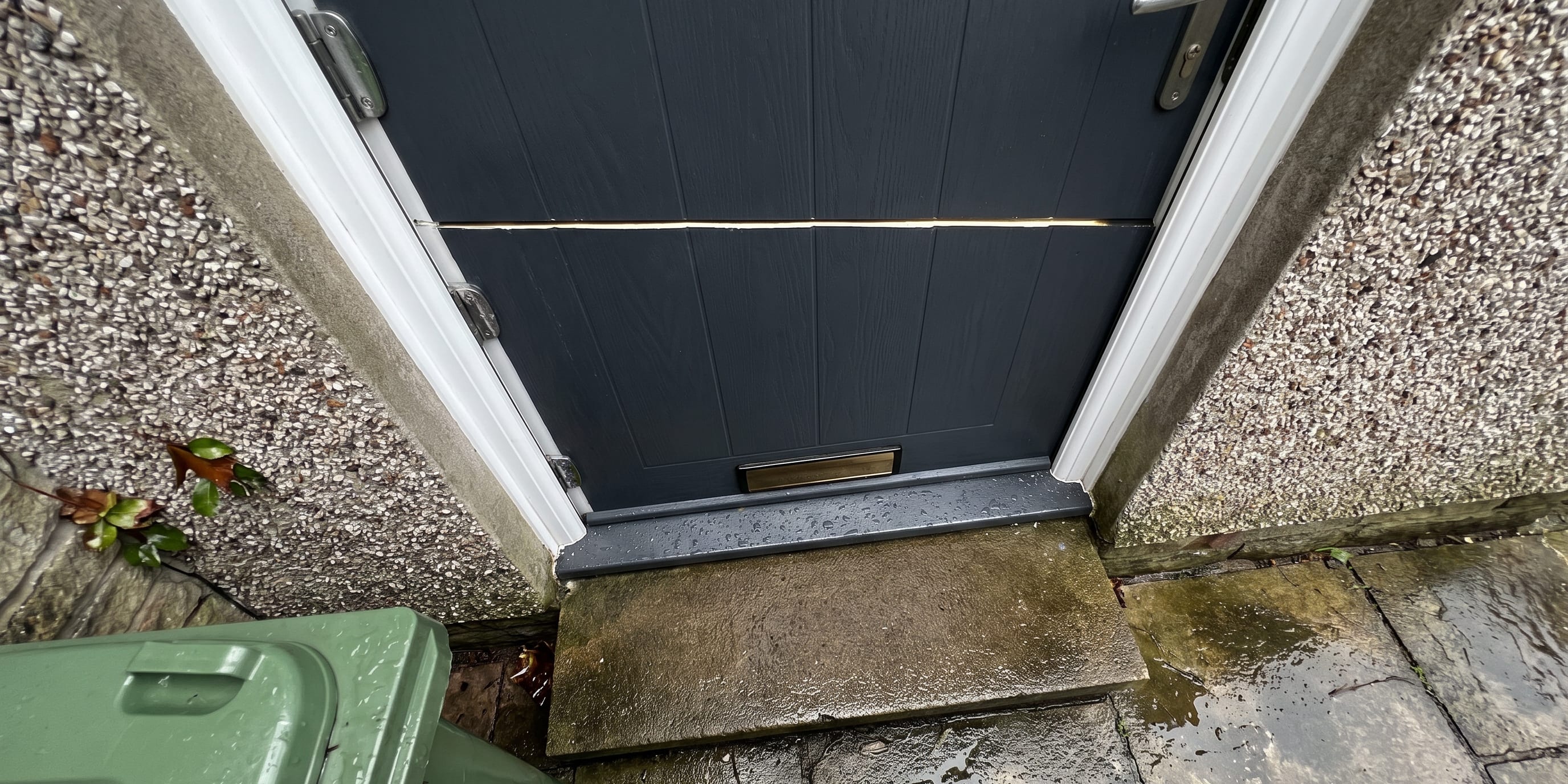
On a door that has dropped, the gap changes as your eye travels along it. Classically, the gap at the top of the handle side opens up while the bottom of the handle side closes in, because the door has rotated slightly on its hinges and the far corner has sunk. You may see the bottom corner touching the frame, or a shiny scuff mark on the weather seal where it has been rubbing.
The other everyday signs:
It catches at the bottom on the handle side. You have to lift the handle slightly or push the door inwards at the bottom to get it past the frame.
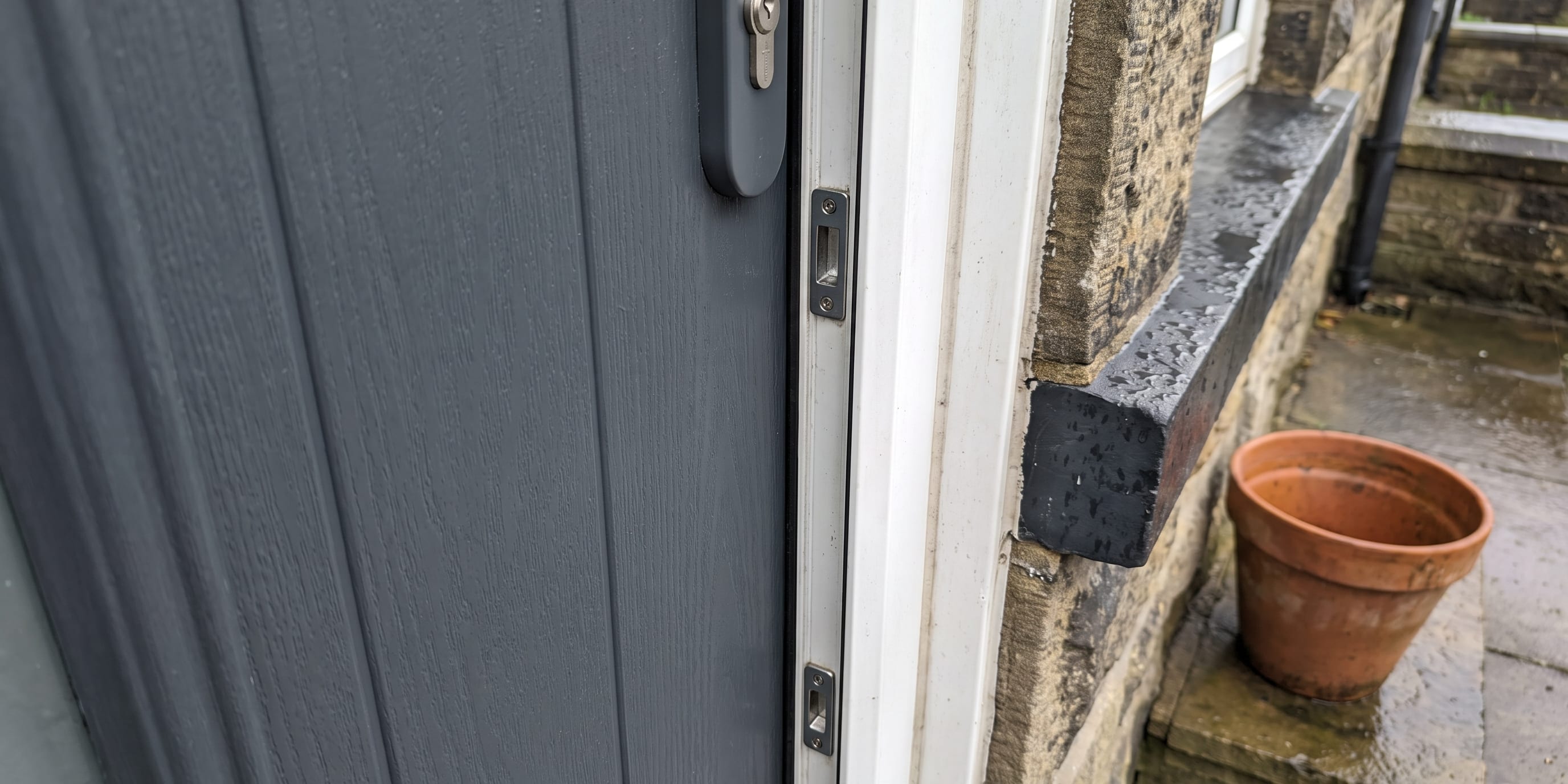
The multipoint lock will not throw unless you lift. On a composite door you lift the handle to engage the hooks and bolts up and down the edge. If the door has dropped, those hooks no longer line up with their keeps in the frame, and you find yourself lifting the whole door with your other hand to make it work.
Draughts in new places. The seal only works when the door sits squarely against it. If a corner has pulled away, you will feel cold air at that corner and nowhere else.
Note which of these you have, and note where on the door they are. That alone tells you most of what you need to know.
Three different problems that look the same
Composite door hinge sagging gets used as a catch-all phrase, but there are three distinct things going on behind those symptoms, and they are not equally serious.
The hinges have drifted. Composite door slabs are heavy. Over years of opening and closing, the compression and lateral adjustment on the hinges can shift fractionally, and the door settles. The slab itself is fine. The frame is fine. The door needs bringing back into alignment and it will then behave for a long time. This is the small job, and it is also the most common one.
The slab has warped. A composite door is a GRP skin over a core, inside a timber or composite sub-frame. South-facing doors in dark colours take a lot of heat, and a slab that has bowed will never sit flat against the seal no matter how the hinges are set. The tell is that the door touches the frame in the middle of an edge rather than at a corner, or that it rocks slightly when closed. Warping is not a hinge problem and adjusting hinges will not fix it.
The frame has moved. If the opening itself has shifted, or the frame was never packed and fixed squarely in the first place, the door is being asked to fit a shape that is no longer rectangular. You will often see the problem repeated nearby: a window in the same wall sticking, or a hairline crack in the plaster above the door.
Who to call, depending on which one you have
If the door is still inside its guarantee period, ring the firm that fitted it. This is the first call in every case, regardless of which of the three problems you think you have. A door that has dropped within its guarantee is their responsibility to assess and put right, and you should not be paying anybody for a diagnosis they owe you. Dig out the paperwork before you phone.
If the guarantee has expired and you believe it is a hinge, a locksmith is usually the right call. A one-off adjustment on a straightforward composite door is a short visit for someone who does it regularly. A general door engineer will do the same work. It should not be an expensive job.
To be clear about where we sit: Win-Door Fit does not offer hinge adjustment as a standalone service. We would rather tell you that plainly than take the call and then let you down. What we do is supply and fit new composite doors, which is the right answer for some people reading this and the wrong answer for plenty of others. If an adjustment will sort your door, have it adjusted.
If the slab has warped or the frame has moved, you are into replacement territory, and that is a supply-and-fit job rather than a repair.
When adjusting has become throwing good money after bad
Here is the pattern worth watching for. The door drops. Somebody adjusts it. It is lovely for a few months. Then it drops again, and you book another visit, and the cycle repeats on a shorter and shorter interval.
When the sag keeps recurring like that, it is not a hinge setting problem. Hinges that have been correctly adjusted on a sound door and frame stay where they are put. A door that keeps returning to the same wrong position is being pulled there by something: a slab that has absorbed moisture and gained weight, hinge fixings that have lost their grip in the frame, or an opening that is still on the move. That is the point to stop adjusting and get someone to look at the whole opening instead.
Two things feed the decision. The first is the door’s age. A door in its first few years that has dropped once is almost certainly a straightforward adjustment. A door well into its second decade, on its third or fourth adjustment, is a different conversation. The second is the adjustment history. One adjustment is maintenance. Three in two years is a diagnosis.
Why some doors never sag at all
It is worth understanding why this happens, because it determines whether a replacement solves the problem permanently or just resets the clock.
Two things decide it. The first is hinge quality and specification. A composite slab is heavy, and hinges have to carry that weight on three fixing points for twenty years of daily use. Properly specified hinges, fixed into solid material in the frame rather than into the thin outer wall of a profile, hold their position. Underspecified ones do not.
The second, and arguably the bigger one, is whether the frame was installed square and properly supported. A frame fitted into an out-of-square opening, packed thinly or fixed in too few places, is under stress from day one. Everything that follows, including the sagging, flows from that. This is why a door can be a perfectly good product and still perform badly: the product was never the problem.
A replacement that addresses both, with the opening surveyed first, the frame installed square and packed and fixed through to solid material, does not inherit the fault. That is the difference between a new door and a new door fitted properly.
What a ten-year insurance-backed guarantee actually does
If your door is still under warranty, you may also hold an insurance-backed guarantee certificate, and it is widely misunderstood.
An insurance-backed guarantee does not replace the installer’s own guarantee. It sits behind it. If a hinge sags on a door still in warranty, you claim against the installer and they put it right. The insurance-backed guarantee is what you fall back on if that firm has ceased trading or otherwise cannot honour the promise it made. In that situation the policy covers work the installer’s guarantee would have covered.
Two practical points follow. The cover mirrors the original guarantee, so what it will and will not pay for depends on those terms rather than on anything the insurer invented. And keep the certificate with your installation paperwork, because a claim needs both.
When a written price for a new door is the better spend
There is no formula for this, but the question is reasonably simple: are you repairing a door that works, or propping up one that has failed?
A door that has dropped once, closes properly after adjustment and stays put is a door that works. Keep it.
A door whose slab has bowed, whose frame has shifted, whose hinge fixings no longer grip, or which has swallowed several adjustments in quick succession, has failed. The money you spend on the next adjustment buys a few more months of a door that already does not seal, does not lock cleanly and does not keep the weather out. At some point the arithmetic turns, and most people recognise the moment when it arrives.
If you have reached it, find out what the alternative actually costs, in writing, before deciding anything. A home visit should involve someone measuring the opening properly, checking whether it is square, looking at the state of the existing frame and reveal, and asking what you want the door to do. Then one written price covering the door, the frame, the hardware, the fitting and the making good, so you can compare it fairly against another quote and against the cost of carrying on as you are.
If your door has reached that point, you can look at the specification and hardware behind Win-Door Fit’s composite front doors and arrange a home visit for a written price with no pressure to go ahead.
Questions
Frequently Asked Questions
Is a sagging composite door always a hinge problem?
No. Hinges are the most common cause and the easiest to put right, but a door that has warped in the heat, or a frame that has moved because the opening has shifted, will produce very similar symptoms. The difference matters, because only the hinge case is a small job.
Can Win-Door Fit adjust my composite door hinges?
We do not offer hinge adjustment as a standalone service. If your door is still under guarantee, the firm that fitted it should put it right at no cost. For a one-off adjustment outside guarantee, a local locksmith or a general door engineer is the right call. We supply and fit new composite doors when a door has genuinely failed.
How many times can a composite door be adjusted before it needs replacing?
There is no fixed number, but a door that drops again within months of each adjustment is telling you the problem is not the hinge setting. At that point further adjustments are money spent on a symptom rather than the cause.
Does a ten-year insurance-backed guarantee cover a sagging door?
It depends on the wording of your certificate. An insurance-backed guarantee generally steps in if the original installer is no longer trading, and it mirrors what that installer’s own guarantee promised. Read the certificate and the installer’s guarantee together before assuming you are covered or that you are not.
Do I pay for a survey before getting a price for a new door?
A home visit to measure the opening and give you a written price should not cost you anything. You should expect one price covering the door, the frame, the hardware and the fitting, with no separate charges appearing later.