
Can Hear the Traffic Through My Windows: Glass or Frame?
If you can hear the traffic through your windows clearly enough that it bothers you in the evening, the instinct is usually to start researching glass. Acoustic laminate, thicker panes, wider cavities, different thicknesses in each leaf. All of that is real and all of it does something. But it is the second question, not the first.
The first question is whether the window you already own is still doing its job as a sealed box. Because glass only performs when it is held in a frame that closes tight, sits square in the opening and is properly sealed to the wall around it. Fit excellent glass into a frame that has given up and you will have spent money on the wrong half of the window.
This piece is an honest way of working out which of those two situations you are in.
Let us deal with "soundproof windows" first
There is no such thing. Any window advertised as soundproof is being sold to you with a word that does not survive contact with a busy road.
What a well made, well fitted window does is reduce how much sound energy gets through, and it does that better at some frequencies than others. The higher pitched parts of traffic noise, tyre hiss, brake squeal, car doors, respond well to better glazing. The low frequency rumble of lorries and buses is far more stubborn, and a good deal of it is arriving through your walls, floor and roof rather than your windows at all.
So the realistic goal is not silence. It is taking the sharp, intrusive edge off the noise so that it recedes into background rather than demanding your attention. That is a genuinely worthwhile outcome and most people are happy with it. It is just not the same as the promise some adverts make.
How to check your frame is still sound
Before anyone talks to you about glass specification, do this yourself. It takes about ten minutes per window and it will tell you more than any online comparison chart.
Feel for draughts along the opening edge. Pick a windy day and run the back of your hand slowly around the join between the opening sash and the frame, particularly along the bottom and the hinge side. Air and sound follow the same routes. If you can feel moving air, sound is coming through there too, and no amount of glass upgrading will change that.
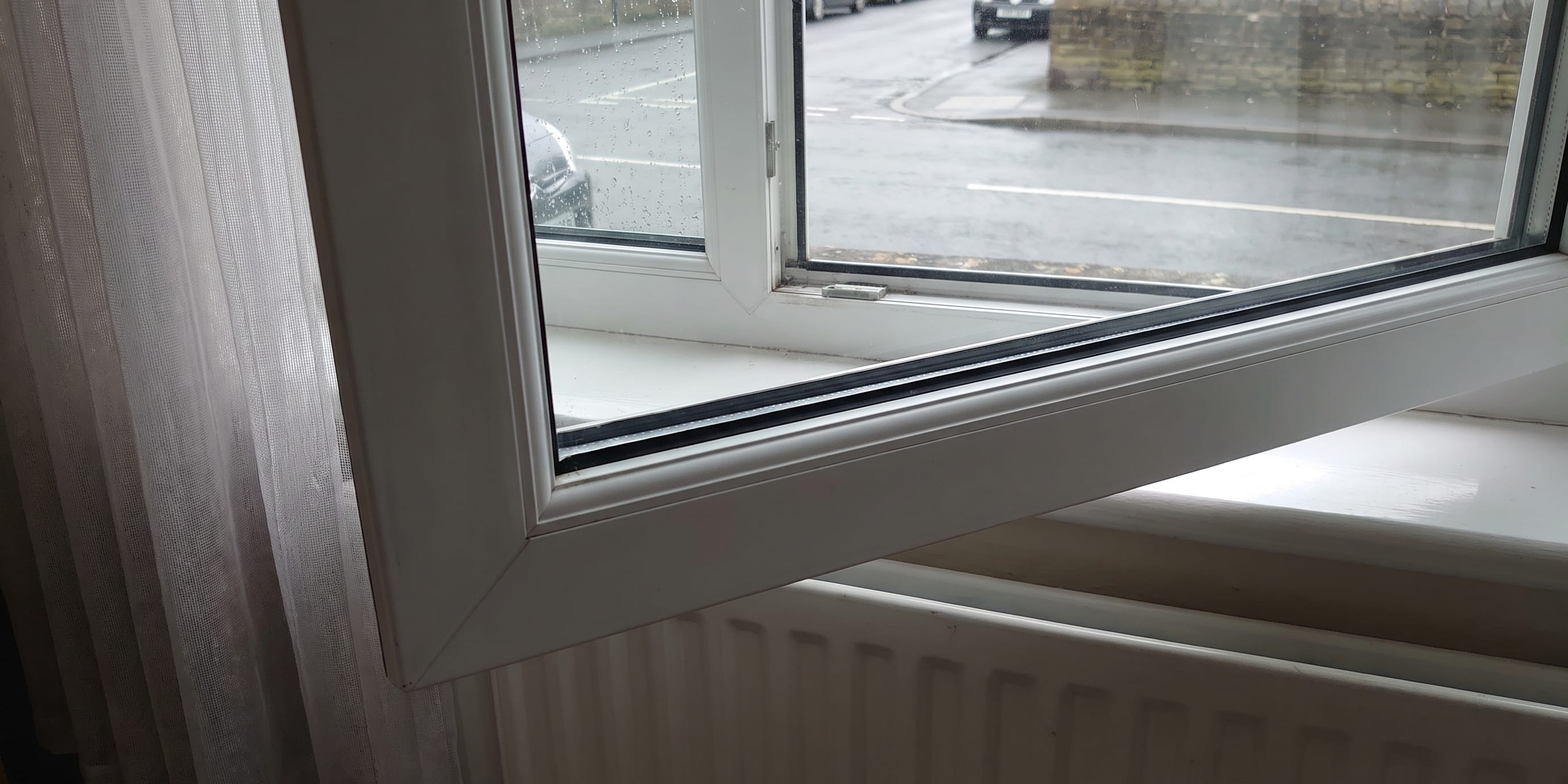
Look at the rubber gaskets. The black seal that runs around the frame should be soft, continuous and springy. Press it with a fingernail. If it is hard, shiny, cracked, shrunk back at the corners or has pulled out of its channel anywhere, it is no longer compressing properly when the window shuts. Gaskets are a wearing part. On older uPVC they very often fail long before the frame itself does.
Check how the sash closes. Open the window and look at the gap between sash and frame as you push it shut. It should meet evenly all the way round. If it touches at the top and leaves a visible line at the bottom, or vice versa, the sash has dropped or the frame has moved. That gap is a direct path for noise.
Look at the outside perimeter. Where the frame meets the brickwork or render there should be a continuous, intact seal. Look for cracked or shrunken silicone, gaps you can see daylight or mortar through, or places where the original installer simply filled a wide gap with expanding foam and trimmed it flush. That joint is one of the most commonly overlooked noise routes in a house.
Check for warping and movement. Stand back and sight along the frame. Older uPVC on a south facing elevation can bow over many years of heat cycling. A frame that is no longer straight will never seal evenly along its whole length.
Do not forget the trickle vents. If your windows have vents along the top, they are deliberate holes in the building. They serve a purpose and they should not simply be blocked up, but they do carry noise, and some designs carry considerably more than others.
Upgrading the sealed unit versus replacing the window
These are genuinely different jobs with different costs and different outcomes, and the right one depends almost entirely on what you found in the checks above.
Swapping the sealed unit into your existing frame means the frame, hinges, handles and gaskets stay where they are. The old double glazed unit comes out, a new one goes in, often to a different specification: a wider cavity, different pane thicknesses, or an acoustic laminated pane on the outer leaf. The work is quicker, there is no disturbance to plaster or brickwork, and it costs less than a full window.
This is the right call when your frames came back clean from the checks. Square, tight closing, healthy gaskets, properly sealed to the wall, no draughts. In that case the existing frame is already doing its part and the glass is the limiting factor, so improving the glass genuinely improves the result. This is the sort of situation our double glazing upgrades work is aimed at.
Replacing the whole window means the frame comes out and a new one goes in, with the perimeter made good and sealed properly. It costs more and it is a bigger day’s work. But it is the only option that addresses frame failure, poor original fit, warping, worn out hardware and a badly sealed perimeter all at once.
This is the right call when the frame itself is the leak. Frames that whistle in the wind, sashes that no longer pull up tight, perimeter gaps packed with foam and hope, or units from an era when the install standard was simply lower. A modern frame system with multi chamber profiles and proper compression seals closes against itself far more consistently than a tired one, which is why our replacement windows on the REHAU system are specified with the seal as much as the glass in mind.
Why the frame and the installation matter as much as the glass
It helps to think of a window as a container rather than a barrier. The glass is one wall of that container. The frame is the rest of it, and the joint between frame and wall is the lid.
Sound behaves like water in this analogy. A small, continuous gap undoes a great deal of good work elsewhere, because the sound simply takes the easy route rather than fighting through the dense bit. This is why two windows with identical glass can perform noticeably differently in the same house, and why an upgraded unit sometimes disappoints: the gap was never closed.
Installation quality is doing a lot of the work here. How the frame is packed and fixed, whether the gap to the wall is filled and sealed on both faces, and whether the sash is adjusted to compress evenly all round will all change the result more than a small step up in glass specification would.
It is also why glazing specifications quoted in isolation should be treated with some caution. Acoustic performance figures come from laboratory tests on a perfectly installed sample in a test rig. Your window is in a wall, in a house, with a trickle vent, a letterbox two metres away and a hundred year old opening that may or may not be square. The lab number tells you how the product can perform. It does not tell you how your window will perform. Any installer who leans hard on the number and does not want to look at your opening is telling you something about their priorities.
What to realistically expect
For a glazing upgrade into a sound frame, expect traffic noise to become less sharp and less present. Conversation and television become easier at lower volume. The change is usually described as the noise moving further away rather than disappearing.
For a full replacement where the old frame was genuinely failing, the improvement is often larger, partly because you are gaining both the glass and the seal at once, and partly because draughts and rattles go at the same time.
For either option, expect heavy vehicle rumble to be the last thing to improve and the least improved. Expect noise to keep arriving through other routes, so if you have an old back door, a single glazed landing window or an unsealed loft hatch, the window work will reveal them. And expect that a window on a direct, close road will never match one on a quiet cul de sac, whatever is fitted.
When to stop guessing and get someone to look
Noise problems are the single worst thing to diagnose over the phone. Nobody can hear your road, see how your frames sit in the opening or feel where the draughts are from the other end of a call. An online specification sheet is worse again, because it answers a question about glass when your question may well be about a seal.
If you have done the checks and you are confident the frames are sound, a glazing upgrade is a reasonable thing to price. If you found draughts, hard gaskets, uneven closing or gaps at the brickwork, do not spend money on glass until someone has looked at the frame.
Either way, a written price after a home visit is the only version that means anything, because it is the only one based on your actual window rather than a description of it. If traffic noise is wearing you down, get in touch and arrange a home visit so someone can tell you honestly which half of the window is letting you down.
Questions
Frequently Asked Questions
Will thicker glass stop traffic noise completely?
No. Thicker or acoustic glass can make a noticeable difference to how intrusive traffic sounds, particularly the higher frequencies, but no window removes noise entirely. Low rumble from heavy vehicles travels through walls, floors and roofs as well as windows, so the glass is only ever part of the picture.
How do I know if my window frame is still sound enough to upgrade?
Check for draughts around the opening sash on a windy day, look for perished or shrunken rubber gaskets, see whether the sash still closes evenly against the frame on all four sides, and look for gaps or failed sealant where the frame meets the brickwork. If the frame is square, dry and closing tight, a glazing upgrade is usually worth considering.
Is replacing just the sealed unit cheaper than a new window?
Generally yes, because the frame, hinges and fittings stay in place and the work is quicker. Whether it is better value depends on the condition of that frame. Putting good glass into a frame that no longer seals is money spent on the wrong half of the problem.
Why does my new double glazing still let traffic noise in?
Common reasons include an unsealed or poorly packed gap between the frame and the wall, a sash that is not compressing evenly against its gaskets, trickle vents, or simply that the noise is entering through another route such as a letterbox, loft hatch or an adjacent door.
Should I get a quote over the phone or arrange a home visit?
For noise problems specifically, a home visit is far more useful. The cause is often something that cannot be described down a phone, such as how the frame sits in the opening or where the draughts actually are. A written price after an inspection tells you what you are buying.