
1990s Double Glazing: Repair the Glass or Replace?
If your windows went in during the 1990s, you are in an awkward middle ground. They are not old enough to be obviously past it, the way a rotten timber sash is. They mostly still open, still close, still keep the rain out. But they were made to a specification that has been overtaken twice over, and the parts that fail tend to fail quietly.
Most advice you will find online falls into one of two camps. Either it sells you a glass-only swap, because that is the cheap, fast job, or it gives you a generic checklist of misting and draughts that applies equally to a window from 2005. Neither helps much if what you actually want to know is whether a 1990s install is worth keeping.
So here is what is specific to that era, and a straightforward test for deciding between new glass and new windows.
The 1990s cohort has its own tells
uPVC from the 1990s is not the same product that goes in today. Formulations, stabiliser packages and profile design have all moved on, and the visible symptoms follow from that.
Yellowing and chalking. White uPVC of that period was more prone to discolouration under ultraviolet light than modern profile. You will usually see it worst on the south and west elevations, and it tends to be uneven, so the frames on one side of the house look noticeably warmer in tone than the ones in shade. Run a finger down the face of a badly weathered frame and you may pick up a fine white powder. That is surface chalking, where the outer layer has broken down. On its own, discolouration is a cosmetic problem. Combined with the next two signs, it is a warning that the material itself is tired.
Bowing and warping. Longer spans, particularly wide fixed lights, patio door outer frames and the head of French door openings, can develop a visible bend. Sight along the frame from one end rather than looking at it face on. If a mullion is bowing, a window may still shut while the seal pressure along its length is wildly uneven, which is why one corner of a room feels draughty and the rest does not.
Sagging sashes. The classic 1990s casement complaint. Friction stays wear, the sash drops a few millimetres at the leading edge, and the window either catches on the frame or needs a shove and a lift to engage the lock. People live with it for years. The hinge can often be replaced if the pattern is still available, but a dropped sash that has been forced for a decade has usually distorted the sash corner welds too.
Perished gaskets and blocked drainage. The rubber seal around the glass and the sash shrinks back from the corners and goes hard. Once it loses its spring, it stops sealing, and the frame drainage slots at the bottom of the outer frame silt up at the same time. Water sits where it should drain away. That is the route by which a minor seal problem becomes a wet windowsill.
Cracked corner welds. Look at the four corners of each sash and the outer frame. Hairline cracks at the weld line mean the frame has lost rigidity and is flexing under load. There is no repair for this worth paying for.
What is inside the glass matters too
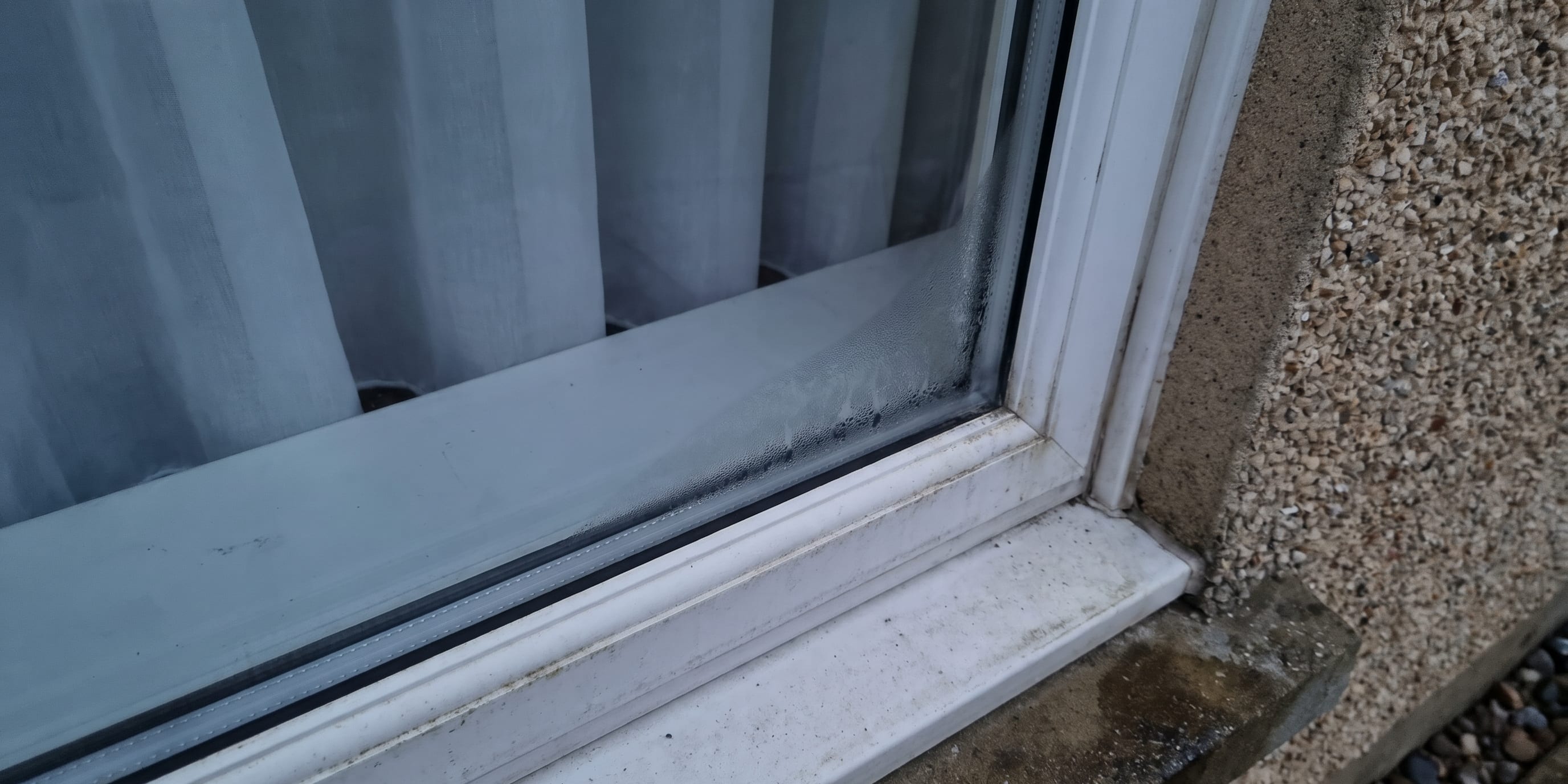
Most 1990s sealed units were built with aluminium spacer bars, air fill rather than argon, and either no low emissivity coating or an early hard coat version. That combination performs nothing like a current unit. The aluminium spacer conducts heat straight around the edge of the glass, which is why you get condensation forming in a band at the bottom of the pane on cold mornings even when the seal is intact.
Misting between the panes is the obvious failure. Less obvious is a unit that has not visibly failed but has lost whatever gas fill it had and is now simply an expensive sheet of single glazing with a gap. If a room has never felt warm despite the heating going full tilt, the glass specification is a likely culprit.
The regulations have moved on, and that changes the maths
Three things happened after your windows were fitted.
Energy standards tightened. Replacement windows now have to meet a minimum thermal performance, which in practice means a modern coated, gas filled unit in a frame designed to work with it. You cannot reach that standard by dropping a good unit into a 1990s frame, because the frame is part of the calculation. This is the single biggest reason a glass-only swap sometimes disappoints people: the glass improves, the overall window does not improve nearly as much as expected.
Ventilation guidance changed. Current guidance is built around not making a home’s ventilation worse when windows are replaced, and in practice that means trickle vents feature in most replacement work. A large number of 1990s installs went in with no background ventilation at all, on the assumption that a bit of leakage around the frame would do the job. Seal that house up with modern windows and no vents and you move the moisture problem somewhere less convenient, usually a cold bedroom wall. Any installer who proposes replacing your windows without discussing ventilation has not thought about your house.
Door security was codified. Document Q set out security requirements for doors and windows in new dwellings, built around tested door sets rather than a lock bolted to whatever was handy. It does not apply retrospectively to a replacement door in an existing home, so nobody is going to make you change anything. But it is a useful yardstick. A typical 1990s uPVC door has a two point or three point lock and an ordinary euro cylinder with none of the anti-snap features that became standard after the vulnerability was publicised. Window locking of the era was often a simple espagnolette with a couple of mushroom cams, where current hardware uses more locking points and shootbolts at the corners.
The decision test
Work through these in order. The first "yes" that lands in the replace column usually settles it.
New glass alone is likely to be enough when:
- The frame is square, rigid and free of cracked welds.
- Sashes open and close without lifting, forcing or slamming.
- Hinges, handles and locks still operate smoothly or can be replaced with available parts.
- Gaskets are still flexible and seated.
- Discolouration is surface level only and you can live with the look.
- The failure you are chasing is misting, a cracked pane or a single blown unit.
The whole window needs replacing when:
- The frame or mullion is visibly bowed, or the sash has dropped and no longer sits parallel in the opening.
- There are cracks at the welded corners of frame or sash.
- Water is getting past the frame rather than the glass, or drainage cannot be cleared.
- Hardware is obsolete and no pattern match exists.
- Most of the windows in the house have the same problem, which tells you it is age rather than one bad unit.
- You want a meaningful change in how the house feels and costs to heat, rather than just clear glass.
Doors sit slightly apart from this. A 1990s door with a sound slab and a poor cylinder is worth upgrading at the lock. A door that has dropped on its hinges, where the multi-point mechanism grinds, is better dealt with as a whole unit, because the frame geometry is what is defeating the lock.
If the answer lands on the glass side for most of your house and the frame side for two or three openings, a staged approach is perfectly reasonable. Targeted double glazing upgrades on the sound frames, with full replacement only where the frames have genuinely gone, is usually better value than doing everything at once for the sake of matching.
What a proper home visit looks like
A phone quote on a 1990s property is guesswork. Nobody can tell you down a telephone line whether your mullions are bowed or whether a hinge pattern is still obtainable, so any figure given that way is a placeholder that will move once someone actually turns up.
A genuine home visit means measuring each opening, sighting along the frames, operating every sash and lock, checking the drainage slots, and looking at bead and gasket condition window by window. It means being told which of your windows are fine as they are. It should include the awkward conversation about ventilation, because that is the part that affects how the house behaves afterwards.
What it should not involve is a presentation. A salesman-led visit tends to follow a familiar shape: a long preamble about the company, a headline price that sounds alarming, then a discount that only survives if you sign before the visitor leaves. A price that expires on the driveway was never a real price. You should get a written itemisation you can read in your own time, compare against another quote, and come back to with questions.
If you are weighing up a 1990s install and want the frame-by-frame answer rather than a guess, read what is actually involved in replacement windows and then arrange an assessment, so you know which category each opening in your home genuinely falls into before you spend anything.
Questions
Frequently Asked Questions
Can I just replace the misted glass in a 1990s window?
Often yes, if the frame is square, the hinges and locks still work smoothly and the frame material is sound. A sealed unit swap is a sensible, low cost fix in that situation. It becomes poor value when the frame itself is distorted, the gaskets have perished or the hardware is beyond spare parts.
Do replacement windows have to have trickle vents?
Current ventilation guidance expects replacement windows not to reduce the ventilation already in the home, and in practice that means trickle vents are fitted in most replacement work. Many 1990s windows were installed without them, so a straight like for like swap is rarely what happens today.
Does Document Q apply to my existing 1990s front door?
Document Q applies to new dwellings rather than replacement doors in an existing home, so you are not legally obliged to upgrade. It does tell you how far door security standards have moved since the 1990s, which matters if your door still has an old cylinder and a two point lock.
Is yellowing uPVC just cosmetic?
Sometimes. Surface discolouration and chalking on an otherwise rigid frame is mainly an appearance issue. Yellowing alongside brittleness, cracked welds or visible bowing suggests the material itself has degraded, and that is a structural reason to replace rather than refurbish.
How long should double glazing last?
There is no fixed expiry date. Sealed units and hardware are the usual first failures, while frame life varies with exposure, installation quality and the grade of material used. Windows from the 1990s are generally well past the point where individual parts can be swapped indefinitely.